A tank is the most honest test of any waterproofing. The water is there all the time, on one side, often under several metres of head, and whatever is dissolved in it goes to work on the concrete. For drinking water there is a second question: the waterproofing must not change the water.
Drinking water: what BS 6920 covers
BS 6920 is the British Standard for the suitability of non-metallic products for use in contact with water intended for human consumption. It examines the effect of the product on the water: odour and flavour, appearance (colour and turbidity), growth of aquatic microorganisms, cytotoxicity and the extraction of metals.
In 2022 Evercrete Vetrofluid was tested to BS 6920 by Intertek's laboratory in Sunbury-on-Thames. The product was brushed onto an OPC concrete block in two coats - the first to saturation, the second once the first had dried - cured for 36 days, and then extracted at 23 °C. It met every requirement, and the report (MA7748/A) concludes that it complies with BS 6920-1:2014.
Three practical points follow:
- The test was carried out on fully cured treatment, so plan for the full 36-day cure before a drinking-water tank goes into service, then follow the owner's normal cleaning, disinfection and commissioning procedure.
- The test covers cold water (23 °C).
- A test report is the evidence behind approval schemes such as WRAS, not an approval in itself. If your client or water company asks for a specific approval, ask us for the current documentation.
Wastewater, sewage and aggressive water
Purification plants, sewage and wastewater, wells and storage tanks in contact with aggressive substances are all listed applications on the data sheet - as are biogas plants and slurry stores, where the concrete faces biomass, gases and leachates. Treated concrete has been tested against a range of chemicals by independent and in-house laboratories (Ecobeton chemical resistance summary, 2021):
| Result | Substances |
|---|---|
| No defects | Sulfuric acid 0.1 M (EN 13529), nitric acid 0.1 M, sodium hydroxide 0.1 M, ammonium sulfate 30% solution, ferrous chloride 30% solution, lactic acid 90%, acetic acid 99-100%, hydrogen peroxide 33%, diesel, unleaded petrol, detergents |
| Whitening | Concentrated hydrochloric acid 36-38% |
In other words, it suits dilute acids, alkalis, salt solutions, fuels and cleaning chemicals; containing concentrated mineral acid calls for a different kind of lining. Against chloride-bearing water, ASTM C1543 ponding tests found about 63% less chloride at 10-20 mm depth in treated concrete than in untreated.
The field record matters as much as the laboratory. A rainwater sedimentation tank at WSW Energie & Wasser in Wuppertal was treated in 2003; nineteen years later the operator confirmed in writing that the concrete was stronger and more impermeable to water. For digesters, see the Mechthausen biogas plant. For biogas and slurry floors, Ecobeton's brochure works with a higher rate of around 590 g/m².
Applying Vetrofluid inside a tank
- Empty and clean. Remove sediment, biofilm, loose material and old coatings. Oil and grease must go too - our Degreaser removes them.
- Repair first. Fill honeycombing, tie holes and spalls with a repair mortar, inject leaking cracks, detail construction joints with waterstops and pipe penetrations with puddle flanges or seals. Vetrofluid treats concrete, not gaps.
- Pre-wet old concrete the day before.
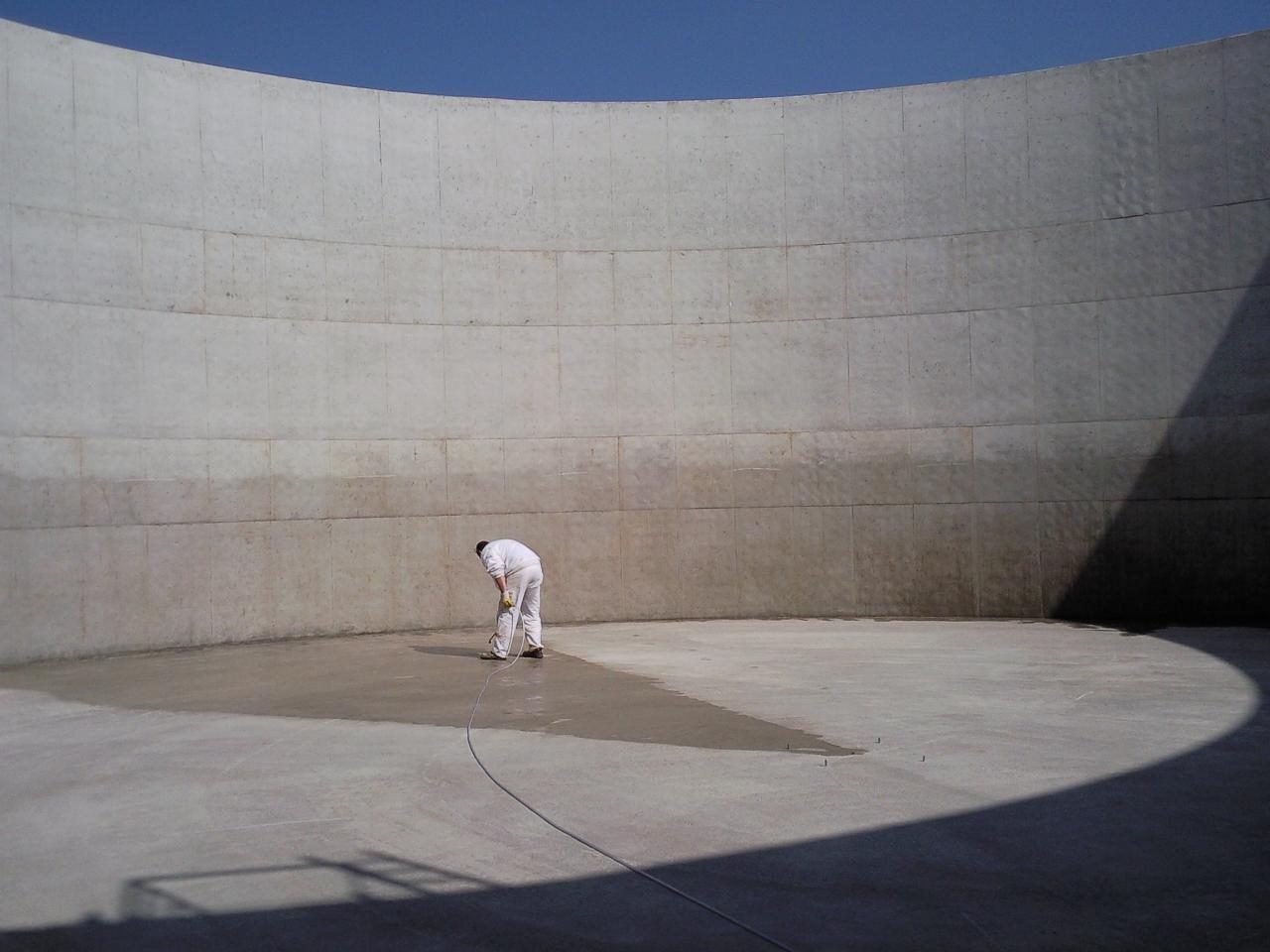
- Apply two coats with a low-pressure sprayer (maximum 5 bar), walls from the bottom up: the first to saturation without dripping, the second once the first has dried. Typical consumption is about 400 g/m² for both coats - the product page calculator gives the quantity.
- Protect fittings. Glass and aluminium can be damaged by the product, so cover them before spraying.
- Mind the temperature. Apply between 5 °C and 40 °C.
- Let it cure. The surface is ready within hours, but the treatment takes 36 days to cure fully - and for drinking water, the full cure comes before filling.
Working inside a tank is confined-space work. Vetrofluid is water-based, odourless, non-toxic and non-flammable (Euroclass A1), which makes it far easier to handle in an enclosed space than solvent-borne coatings - but the usual confined-space precautions still apply.
What this means for UK projects
Service reservoirs, fire-water and rainwater tanks, sewage and treatment works, slurry stores and anaerobic digesters are all concrete boxes that hold water. Draining one is expensive, so plan the repair, the joints, the treatment and the cure time together - it avoids a second shutdown. Waterproof the concrete, engineer the interruptions covers joints and penetrations; contact us to talk through your tank.