Walk round any leaking basement, car park or balcony and look at where the water actually comes through. It is rarely the middle of a wall or slab. It is the line between two pours, the pipe through the wall, the bolt drilled into the deck, the door threshold, the gully. Waterproofing that treats every square metre the same misses the places that matter most.
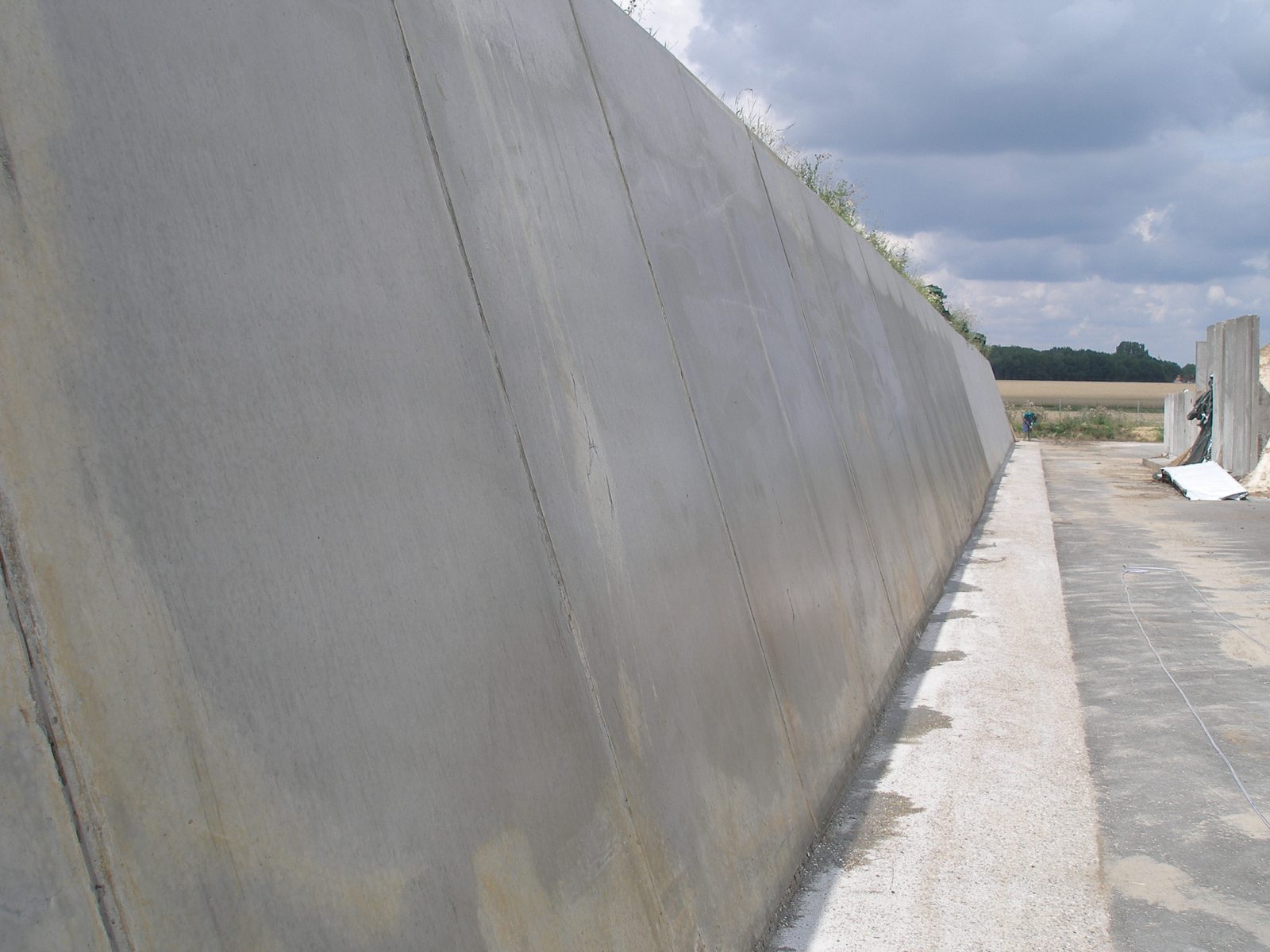
One principle, two jobs
The Ecobeton Vetrofluid Waterproofing System rests on a simple split: waterproof the concrete body, and engineer every interruption.
Where the structure is continuous concrete, Evercrete Vetrofluid is the waterproofing. It is a modified sodium silicate (waterglass) impregnation: sprayed on, it penetrates 10 to 40 mm into the concrete and reacts inside the pores to seal them - the chemistry is explained in How Vetrofluid works. There is no film on the surface to puncture during backfilling, peel in the sun or lift under traffic. The treated concrete is the barrier.
Where the concrete is interrupted - by a joint, a hole, an anchor, a pipe, an outlet, a threshold or a movement gap - a dedicated continuity component does the job. Vetrofluid still treats the concrete around it, but it is never asked to seal a gap it cannot fill. The data sheet is explicit: Vetrofluid is not effective on construction joints, which must be waterproofed with other products such as waterstops.
What the treated concrete does
For the continuous areas, the evidence comes from independent laboratories:
- Water under pressure. In a CRD-C 48 water permeability test (US Army Corps of Engineers method) run by SGS TEC Services, treated concrete cylinders held at 200 psi - about 13.6 bar - for ten days passed no measurable water. The water front stopped at about 25 mm.
- Water absorption. The Air Force Institute of Technology in Warsaw (2023) measured a drop in water absorption of about 73% on treated test cubes and about 80% on cores taken from an existing airfield pavement - old concrete, not just fresh laboratory samples.
- Chlorides. In ASTM C1543 ponding tests (SGS TEC Services, 2021) treated slabs held about 63% less chloride than untreated ones at 10-20 mm depth and about 70% less at 25-35 mm - the zone where the reinforcement usually sits.
- CE marking. Vetrofluid is CE marked to EN 1504-2 as an impregnation for the protection of concrete, with capillary absorption w < 0.1 kg/m²·h0.5 (EN 1062-3) and a Euroclass A1 reaction to fire.
The interruptions, one by one
Construction joints
Wall-to-slab kicker joints, raft joints, lift-pit wall-to-base joints - anywhere one pour meets the next. Vetrofluid treats the concrete on both sides; a hydrophilic waterstop strip or mastic keeps the joint itself watertight. In high-risk places such as lift pits and deep basements, an injection hose can be cast in as secondary security.
Pipe and service penetrations
A pipe through a wall interrupts the concrete completely, so the interface is sealed mechanically: a cast-in sleeve, puddle flange, compression or link seal, or collar - with a fire-rated penetration seal where the location calls for one. Vetrofluid protects the concrete around the opening.
Blind fixings
Bollards, barriers, balustrade posts, plant bases and brackets are drilled into the concrete but do not pass through it. Vetrofluid goes inside the drilled bore as well as on the surface, so the bore wall is treated too; gaskets, EPDM or neoprene washers or gasketed base plates protect the exposed interface. Structural resin is used only where the anchor design requires it.
Thresholds and upstands
Where a balcony or terrace slab meets a door frame or the façade, water collects at the door line. Vetrofluid treats the slab and the upstand; a threshold interface membrane, with pre-formed corners, a termination bar and a compatible primer, links the treated concrete to the building envelope.
Outlets and drainage channels
Outlets concentrate water at a single point. The whole slab is treated, including the concrete around the opening; the outlet body is connected with a flange, clamping ring or collar, with an overflow where required.
Movement joints
A movement joint is a deliberate gap. Vetrofluid treats the joint shoulders and arrises on both sides; a flexible joint band or waterbar bridges the gap and allows the designed movement.
Where the system applies
The system is deliberately focused on concrete: raft slabs and basement walls, lift pits and sumps, basement car parks and column bases, podium slabs, balconies and terraces, roof slabs, upstands and parapets. It is not a brick, façade or general roofing membrane. Drainage boards, root barriers and geotextiles come into it only where a project includes planters or green or blue roofs.
Getting the details right
- Ask for evidence on every component: technical data sheet, DoP where applicable, fire classification, compatibility with Vetrofluid-treated concrete, standard details and the installation method statement.
- Prepare the concrete: remove release agents and any oil or grease - our Degreaser does this - and repair tie holes and honeycombing with a repair mortar before treatment.
- Apply it properly: two coats with a low-pressure sprayer (maximum 5 bar), the first to saturation without dripping, the second once the first has dried; vertical surfaces from the bottom up. Typical consumption is about 400 g/m² for both coats (250-500 g/m², depending on how absorbent the concrete is) - the calculator on the Vetrofluid page works out the quantity. Apply between 5 °C and 40 °C, and protect glass and aluminium, which the product can damage.
- Sequence the trades: treated walls can be backfilled after 12 hours, and plaster or concrete can follow after a few hours; paints and resins need 2-3 weeks. Full cure takes 36 days.
What this means for UK projects
On basements, car parks and podiums, most of the area is continuous concrete - and that part can be waterproofed by spraying. The design effort belongs at the interruptions: mark them on the drawings first, choose a component for each, and the leaks have nowhere left to start. For below-ground work, read Waterproofing basements with Vetrofluid; for water-retaining structures, Waterproofing concrete tanks. Or talk to us about your project.