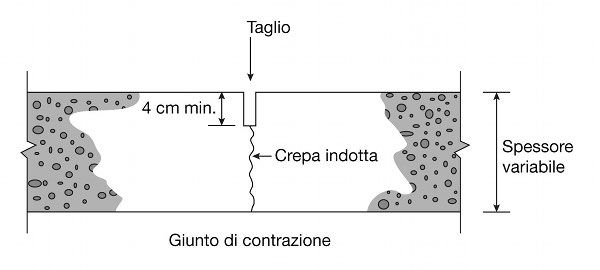
Contraction joints - sometimes called control joints - are the most widespread way to control cracking in industrial floors. As concrete hardens it loses volume, and that very often cracks the slab. Cutting the floor at regular intervals weakens it at chosen points so cracks "prefer" those paths.
Joints are partly cosmetic - the crack forms beneath the cut, giving the impression of an orderly, crack-free surface - and partly functional, making it far easier to seal and waterproof the floor continuously.
Let the slab move
The slab must be free to move relative to the sub-base, with as few restraints as possible: a polythene or geotextile slip layer beneath the pour, and a 1-2 cm compressible strip around the perimeter. Single or double welded mesh helps contain cracking and ties the panels together beneath the joints, provided it sits at the right height. Well-dispersed fibres also give excellent results; structural fibres can replace steel mesh wholly or partly, with benefits during placing.
Layout rules
Design joints to form squares, or at most rectangles whose long side is no more than 1.5 times the short side. Spacing should be 24 to 30 times the slab thickness, and depth one quarter of the thickness. On a 200 mm floor: squares of 4.8 m, or rectangles up to 3.2 m x 4.8 m, cut 50 mm deep. Shallow joints fail to seed the crack in the right place, and cracks then appear at random.
Timing and clean-up
Cut as soon as the saw can do so without tearing or chipping the edges - and never later than 24 hours. Sawing produces large amounts of highly alkaline cement and aggregate dust; left on the surface it causes discolouration and changes in surface texture. Rinse meticulously after cutting.
Curing
To cut plastic shrinkage cracking, wet curing with Evercrete Pavishield is essential (see curing to EN 13670). The ideal sequence: mist Pavishield as soon as finishing ends; cut the joints; rinse off the sawing slurry; apply Pavishield again; brief final rinse.