The screed has always been seen as the poorest element of a building, and has always received scant attention to its technical details. To be precise: a screed is the non-structural horizontal layer that brings a room to level and receives the final floor - tiles, parquet, resin - distributing the loads on it. It has traditionally been under-designed and even more carelessly built, and got away with it because discontinuous finishes (tiles, boards) are little affected by a weak substrate.
Yet how often have you had tiles that sound hollow, come loose, or crack? Many times, surely - and few stop to ask why.
With the growing demand for seamless finishes - microcement and resins, favoured by architects and designers - attention to the screed has become as common as it is thorny. Many build-ups, many materials, many methods; but one parameter is common to all: a weak, dusty surface layer.
Bleeding
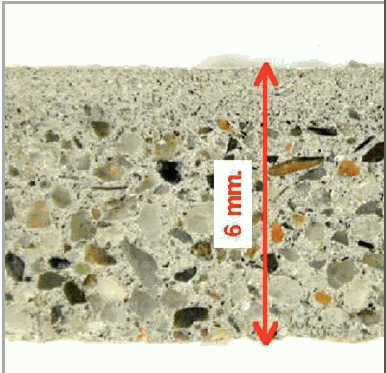
It is very hard to find a screed - self-levelling or hand-screeded - that does not leave your hand dusty. The main cause is bleeding: the heavier fractions of the sand-cement mix settle while fines are carried to the surface by the mix water. The top skin is therefore the weakest part. In anhydrite (calcium sulphate) screeds this often causes surface delamination. Irrelevant under tiles and parquet, it is critical under seamless finishes, which may suffer immediate adhesion problems, later detachment, and above all reduced resistance to impact and load: the strength of a thin seamless finish is determined first of all by the strength of the substrate beneath it.
Two remedies
Either grind off the surface layer (1-2 mm is usually enough) to remove the weak skin, or consolidate the cement structure with a penetrating silicate treatment such as Evercrete Pavishield, which soaks in and compacts the weak skin. Simply spray it with a low-pressure garden-type pump: surface strength rises and dusting disappears, the surface is unchanged, and any finish can then be applied.
See finished projects and the full UK microcement range on our microcement floors and walls page.