Excess moisture in screeds is known to damage floor coverings - timber, linoleum, resins. Rising moisture carries alkalis and salts to the surface, where they attack adhesives and coverings and cause detachment.
Spot methods are normally used and accepted: calcium carbide, contact hygrometers, electromagnetic meters. But they are wholly inadequate for investigating or preventing the problem, and their results are hard to compare. The point is not how much water a pour contains, but how much moisture can move up through the floor, and under what ambient temperature and humidity it becomes dangerous for the covering.
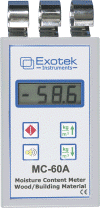
Moisture is often partly absorbed or condensed and moves through concrete by diffusion rather than as free water or vapour. Transmission depends on the degree of saturation, itself a function of relative humidity on each side of the pour. Moisture movement through concrete is governed by the relative humidity differential rather than by vapour pressure - so it must be measured over time.
In the 1980s the Scandinavian countries developed techniques for measuring relative humidity (RH) within, or in equilibrium with, the pour - widely shared by the Portland Cement Association, and curiously little known elsewhere. RH is an equilibrium measure: once a covering is installed it acts as a vapour barrier and stops evaporation from the top; moisture redistributes until equilibrium is reached.
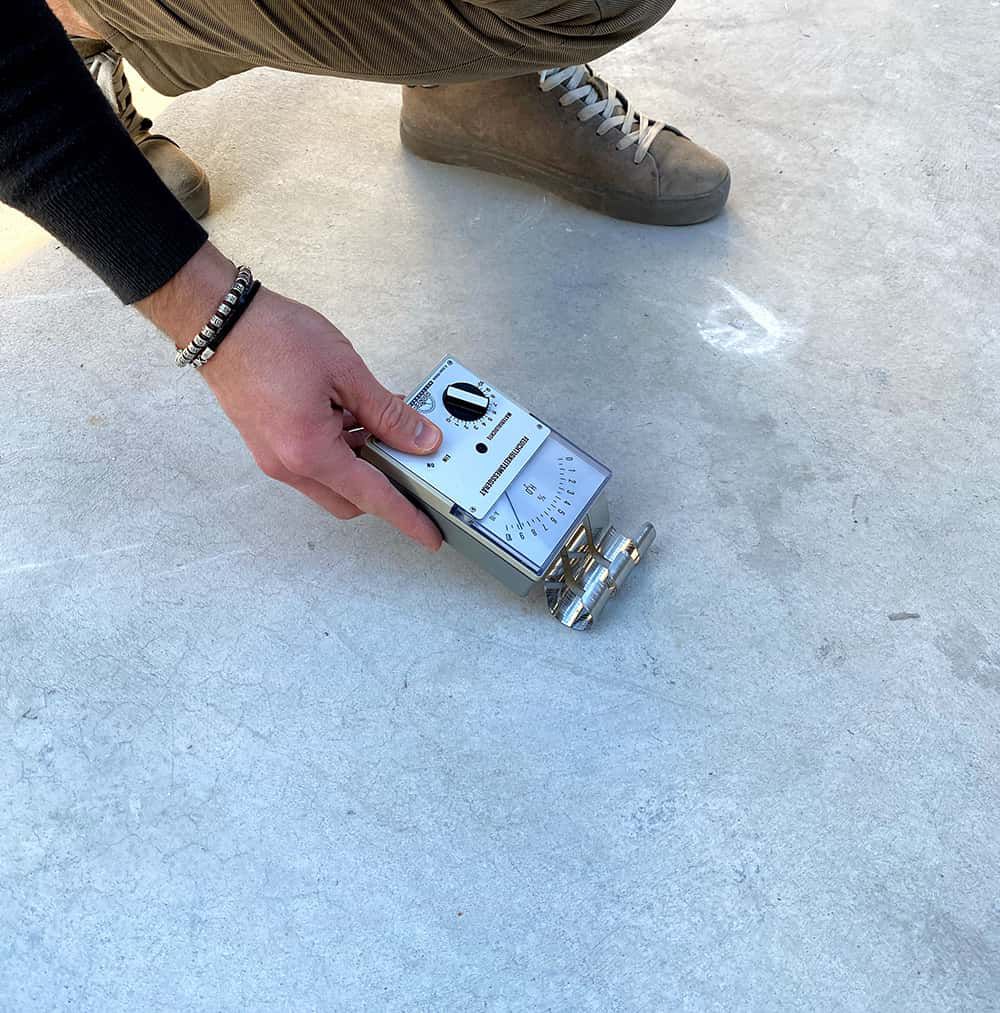
Acceptable RH levels
The acceptable level depends on the use of the space and the covering. In an ordinary industrial floor without a vapour barrier, RH can be quite high: vapour passes through and evaporates at the surface - though condensation on or within the slab (interstitial condensation) is not rare when the dew point is reached. To minimise that risk, RH in the top centimetre should stay below 85%. Very closed surfaces - long power-floating or a "dust-proof" sealer - without a vapour barrier can show over 95% in the top centimetre. Roughening (shot blasting, for instance) helps the slab breathe, at the cost of abrasion resistance.
Limits derived from site testing, published in Finland (SisaRYL 2000) and Sweden:
- 85%: plastic carpet on felt or cellular backing; rubber; cork with vapour barrier; textile with rubber, PVC or latex backing; natural-fibre textile.
- 90%: plastic tiles; plastic carpet without felt; linoleum.
- 60%: large timber panels without a vapour barrier between wood and concrete.
- 80%: parquet on concrete; wood and wood-based products; vinyl with backings that could feed fungal growth; bonded coverings that do not tolerate alkalis.
Prevention
Treating the pour with Evercrete Pavishield guarantees RH below 85% within 36 days, whatever the surrounding conditions. Our technical team is available for more.